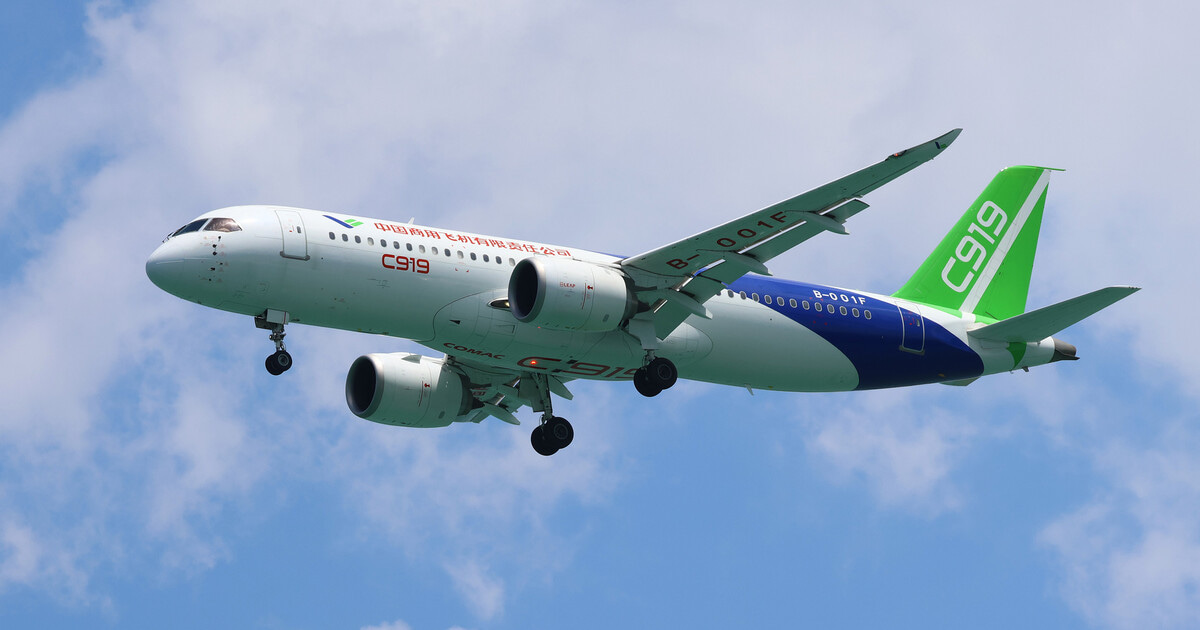
Earlier this year, the first new derivative of Comac's C919 airliner took to the skies over Shanghai. It was not the stretched C919 that many would expect in today's narrowbody market. Instead, the Chinese manufacturer has shortened the aircraft to develop a version intended for some of the world's most demanding high-altitude airports.
The choice is worth examining. Airbus has enjoyed extraordinary success with the A321neo, while its much smaller A319neo has attracted much less demand. Meanwhile, Boeing's larger 737 Max variants have also proved more popular than the smallest member of the family.
Yet Comac's first C919 derivative to enter flight testing is a smaller aircraft, even as the manufacturer continues to face challenges in ramping up production of the baseline C919. Why devote scarce engineering and manufacturing resources to a smaller aircraft, and why do it now? Comac has a different set of priorities.
For Airbus and Boeing, developing aircraft families is primarily driven by commercial considerations. Variants allow manufacturers to serve different market segments while spreading development costs across a common platform.
As of June 2026, the A321neo accounted for approximately 75% of the Airbus A320neo family's order backlog. At Boeing, the larger 737 Max 9 and Max 10 together represented 36% of undelivered 737 orders, compared with just 6% for the smaller 737 Max 7.
Comac faces similar commercial considerations, but its C919 family also carries a national industrial objective. Following the C919's type certification in September 2022, China made both production ramp-up and aircraft-family development explicit national priorities. In a June 2023 statement, Comac subsequently organized its strategy around what it calls the "three major tasks": Production ramp-up and aircraft family expansion; self-reliance; and safety and reliability.
The Chinese airframer is developing both shortened and stretched versions of the C919. But it is the smaller, high-altitude C919-600 that has reached flight testing first.
Why, then, did Comac give the smaller C919-600 priority over the stretched C919-800? The answer begins with a longstanding requirement in China's domestic aviation industry.
Longstanding Need & Launch Customer
Western China presents a unique aviation market. Its vast mountainous regions are home to numerous high-altitude airports, where air transport is vital to mobility, economic development and emergency services. A flight from Chengdu, a major hub in southwestern China, to Lhasa takes about two and a half hours, compared with roughly 35 hours by train and several days by road. The need extends well beyond Tibet into neighboring provinces.
The numbers are striking. Of China's 270 transport airports, 46 qualify as high-altitude under the Civil Aviation Administration of China's definition (5,000 feet/1,524 meters or higher), accounting for roughly a quarter of the world's total. Of these, 25 are classified as ultra-high-altitude airports (8,000 feet/2,438 meters or higher), accounting for more than half of all such airports worldwide with runways longer than 2,000 meters.
Eight of the world's 10 highest civilian airports are in western China, as are the five highest civilian transport airports, while most of China's ultra-high-altitude airports are concentrated on and around the Tibetan Plateau. The need for aircraft suited to these conditions is hardly new.
In January 2010, when Comac was still a newly established company, the CAAC issued a policy document on developing aviation in Tibet. Among its 18 measures was an explicit call to coordinate with aircraft manufacturers to develop and supply high-altitude aircraft.
Tibet Airlines (renamed Xizang Airlines in English in 2026 but referred to here by its former name) was established later that year and began commercial operations in July 2011 with Airbus A319-115 aircraft powered by CFM56-5B7 engines. It has since accumulated more than a decade of experience operating narrowbody aircraft configured for high-altitude service in one of the world's most demanding environments.
Four years later, CAAC went a step further. Its May 2014 policy on Tibetan aviation specifically supported Tibet Airlines in acquiring high-altitude aircraft and expanding services within Tibet and to other parts of China. Behind these aviation policies lies a broader national commitment to developing western China. It includes the paired-assistance program dating back to 1994, under which designated provinces and cities, later joined by major state-owned enterprises, support Tibet's development, as well as the Western Development Strategy launched in 2000 to promote infrastructure investment and economic development across western China.
This history matters because the C919-600 aims to meet a longstanding need that, for decades, no domestically developed mainline jetliner had been available to address.
That changed with the C919. In December 2023, COMAC and Tibet Airlines signed a strategic cooperation agreement to jointly develop high-altitude versions of the C919 and ARJ21, now marketed as the C909. The two state-owned enterprises also agreed to pursue a research center focused on high-altitude operations. At the Singapore Airshow in February 2024, Tibet Airlines placed orders for 40 high-altitude C919s and ten high-altitude ARJ21s, becoming the launch customer for both variants.
The order is only part of what Tibet Airlines brings to the program. After more than a decade of high-altitude operations, the airline has firsthand experience of how airport elevation, terrain, temperature, payload restrictions and diversion requirements affect day-to-day operations. That experience gives Comac a practical basis for defining the aircraft's requirements. The collaboration expanded beyond Comac and Tibet Airlines in May 2024, with the establishment of a research alliance bringing together 13 organizations, including other major Chinese airlines and aviation research institutions, to address high-altitude aircraft design, operations and certification.
For Comac, the stretched C919-800 targets a much broader market, but the C919-600 had something more immediate: a longstanding national need, technical input from an industry alliance and a 40-aircraft launch order.
Flying to Tibet Is Not the Same as Serving Tibet
There is also an obvious question about the aircraft itself. Why develop a dedicated high-altitude C919 when the standard aircraft can already fly to Tibet?
On September 19, 2024, a date handpicked to echo the aircraft's designation, a baseline C919 flew from Chengdu to Lhasa Gonggar International Airport, 3,569 meters above sea level, serving Lhasa, the capital of Tibet Autonomous Region.
It was the first Chinese-developed mainline jetliner to land in Lhasa since January 1984, when the Y-10, a prototype modeled on the Boeing 707 and powered by the same Pratt & Whitney JT3D-7 engines used on China's 707 fleet, made the trip.
The flight had a technical purpose, but its symbolism was hard to miss. Four decades after the Y-10, China had once again demonstrated that it could build a mainline jetliner capable of reaching the Tibetan Plateau. For an airline, however, flying into Lhasa is one thing. Taking off from there with a commercially viable payload, day after day, is another.
At 3,569 meters, thinner air reduces available engine thrust and increases the ground speed required for takeoff. Higher temperatures make matters worse. The surrounding mountains add to the demands on climb performance, particularly following an engine failure. During cruise, mountainous terrain can complicate both an engine-out driftdown and an emergency descent following cabin depressurization. These conditions can impose substantial restrictions on takeoff weight, payload and route planning.
The Airbus A319, long the workhorse of China's high-altitude routes, faces these limitations too. A 2023 analysis published in Comac's Jetliner magazine examined actual flight load sheets from an airline operating A319s between Lhasa and Ngari Gunsa Airport (NGQ), 4,274 meters above sea level.
Although the aircraft had 128 seats, the airline could offer only about 105 for advance sale. Payload was limited to around 10 metric tons, partly because of the additional fuel reserves required by the limited availability of alternate airports.
The C919-600 seeks to ease these payload restrictions by reducing the operating empty weight of the original aircraft. Yet the market for such a specialized derivative is considerably more concentrated than China's impressive number of high-altitude airports might suggest.
How Large Is the Market, Really?
Airport numbers tell only part of the story. According to aviation data provider Flight Master, China's 25 ultra-high-altitude airports handled 9.85 million passengers in 2025, just 0.64% of the country's total airport passenger throughput. Lhasa alone accounted for 63.8% of that traffic.
Beyond Lhasa, traffic is thin. The same study recorded approximately 92,000 passenger aircraft movements across China's ultra-high-altitude airports in 2025. Thirteen airports handled fewer than 1,000 movements each, making the potential aircraft market considerably smaller than the airport count might suggest.
Existing aircraft already serve much of this market. According to Flight Master's analysis, Airbus A319s operated 78.9% of China's ultra-high-altitude passenger flights in 2025. Tibet Airlines, the launch customer for the C919-600, currently operates 15 A319neos alongside 27 older A319s.
A meaningful comparison between the C919-600 and A319neo would require detailed analysis of aircraft performance and operating economics, supported by actual operating data under comparable high-altitude conditions.
Comac's approach begins with the fuselage. According to published reports, the C919-600 removes six fuselage frames, shortening the aircraft by approximately 3.6 meters. The state-owned company has confirmed a planned seating capacity of 140–160 passengers, while reports indicate that the aircraft retains the CFM International LEAP-1C engines used on the baseline C919. The principal benefit is lower aircraft weight, allowing more payload to be carried under high-altitude takeoff restrictions.
Shortening the fuselage also changes the aircraft's center-of-gravity range and longitudinal handling characteristics. These changes require flight-test validation. The program is now in flight testing, with further trials planned at high-altitude airports.
Other reported modifications address specific high-altitude operating requirements. These include an increase in passenger emergency oxygen supply duration from 15 to 60 minutes, as well as BeiDou satellite navigation and Required Navigation Performance Authorization Required (RNP AR) approach capability for operations in mountainous terrain.
Shanghai-based City News Service reported in July 2026 that deliveries to Tibet Airlines are targeted for 2028. Although the aircraft currently uses LEAP-1C engines, China's domestically developed CJ-1000A could eventually become another option for the C919 family. No installation plan for the C919-600 has been announced.
The Other End of the C919 Family
Comac first unveiled a stretched C919 concept at the Shanghai Commercial Aviation Exhibition in November 2023, proposing 210 seats in a two-class configuration. In September 2026, Chinese state broadcaster CCTV reported that the stretched variant could accommodate up to 240 passengers.
China Eastern, the launch operator of the baseline C919, is playing a similar role in the C919-800 program to Tibet Airlines in the C919-600. According to China Eastern's 2025 annual report, the airline and Comac, both based in Shanghai, established a joint innovation center in December 2025 to bring operational experience into the stretched variant's development. Aviation Week reported in June 2025 that Comac was targeting entry into service for the stretched C919 by 2030.
The C919-800 targets the market served by the A321neo, which accommodates up to 244 passengers. For Comac, the engineering challenge is whether the existing C919 platform can accommodate the higher capacity while delivering competitive payload, range and operating economics.
This story was first published by Leeham News and Analysis, which is part of the AIN Media Group. Subscribe here for exclusive coverage of the commercial aerospace sector.
More In Aircraft